How to respond to lower milk price with better forage
27 April 2026
Making a conscious decision to cut earlier and increase the number of silage cuts could help build a bank of quality forage and protect against lower milk prices.

Lower milk prices and the hangover from last year’s drought only serve to underline the value of producing more quality forage this season to optimise margins, says Ken Stroud Technical Business Manager for Volac.
Milk prices have come down and feed costs have increased so true margin has reduced. And many farmers don’t have enough forage to make more milk from forage, so they’re reliant on more concentrate to get milk. In that scenario, profitability is through the floor,” he says. “On the other hand, those producing 4,000-6,000 litres a cow milk from forage are laughing, after all there’s no cheaper feed than homegrown forage.
Ken recognises that last year’s drought made forage growing a challenge. However, eighteen months ago, when milk price was high, and feed costs relatively low, he says some producers made the mistake of trying to reduce forage contracting costs and “buying milk” with bought-in feed. As a result, they did not build a bank of forage to see them through 2025 and the drop in farmgate milk prices.
Don’t forget to look ahead and see the true value of forage. You can’t control the milk price, but you have control over producing forage at a reasonable price,” Ken stresses. “Whatever the market, keep the mower going and keep forage in the clamp or in bales. It’s money in the bank. If it sits in a clamp for two years, it’s still worth the same, but it’s worth even more in a drought year. And even if you don’t need it, someone else might and it’s a seller’s market.
To build forage resilience, Ken says the aim should be to have minimum 20% forage carryover each year. He highlights five easy wins for making more, better quality silage:
1. Cut earlier
Don’t cut by the calendar, judge by stage of growth and aim to cut earlier in the season. Even thinking about cutting one week ahead of “usual” could be beneficial.
Those that cut earlier in 2025 were able to get a cut before the drought. Those that hung on for bulk, struggled with burn off. Cutting earlier helps to clear out any old, over-wintered growth and means the crop is harvested when it’s younger – both of which improve digestibility.
Regularly walk fields and assess the crop. Cutting just before the seed head emerges will produce a crop of optimum quality around 11-12 ME. Yields may be 4-5t/acre, but it will be rocket fuel,” Ken says.
Cutting earlier in the season also sets the system up for making more cuts through the year.
2. Take more cuts
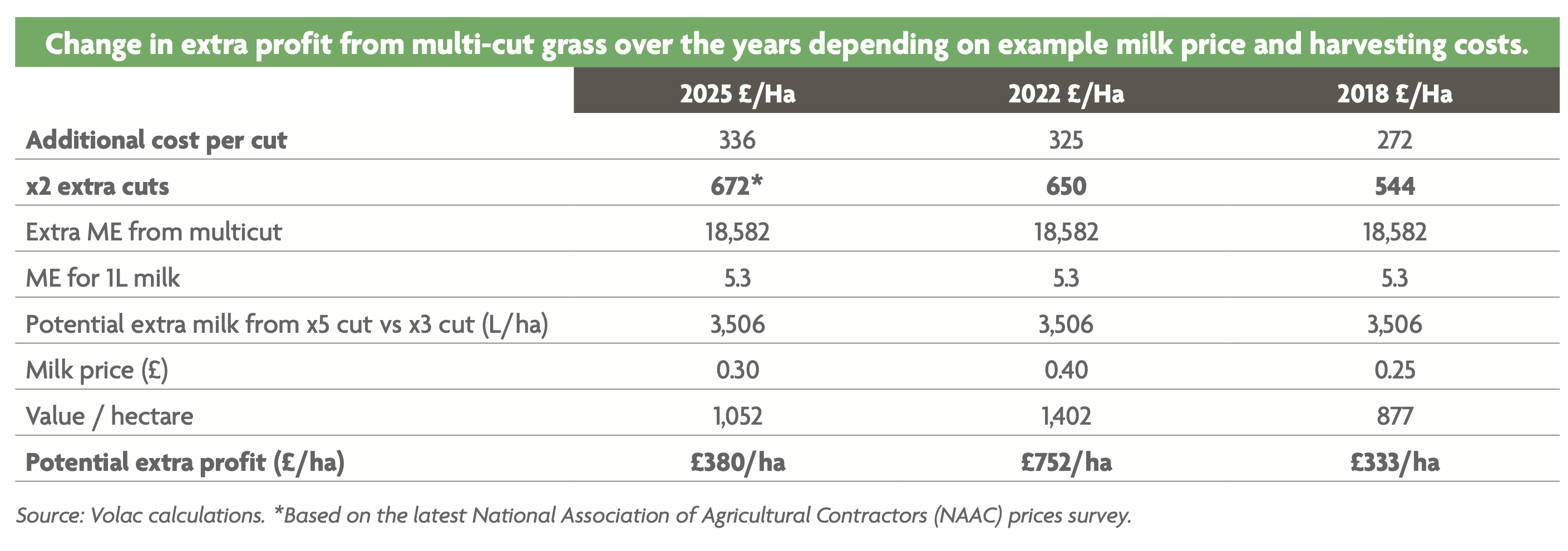
Can you increase cutting frequency? Each individual cut may be lighter, but quality and total dry matter yields across the season can be higher, according to a Volac on-farm study. The study found that fresh-cut grass from a five-cut system delivered 18,582 MJ/ha more metabolizable energy (ME) than three cuts. This was due to the five cut system yielding 0.92t/ha DM more total dry matter (DM) over the season and having a higher average ME. This extra energy could support an additional 3,506 litres/ha of milk from forage.
When we translate the findings of that study using a milk prices of 30ppl, and after deducting up-to-date slurry, fertiliser and contracting costs for two additional cuts, that equates to £380/ha more profit,” Ken says (see table), adding that even upping the number of cuts from two to three or three to four could bring big benefits.
3. Avoid cutting grass too low
Avoid the temptation to “shave grass off”. This will mean grass has no reserves for growth. Those that left a decent stubble prior to going into last year’s drought had better re-growth. Always cut above the leaf node, and never below 5cm, Ken says.
4. Use a tedder where appropriate
A rapid wilt is essential for minimising dry matter (DM) losses in the field. Sixty percent of wilt should occur in the first two hours after cutting. Aim to put the tedder in within an hour of cutting (unless the crop is very light and the weather is extremely hot), leave for 1-2 hours, depending on conditions, and pick it up in the afternoon if it’s reached 30% DM.
5. Use a proven additive
Always use a proven additive to safeguard forage DM and quality. Trying to save money by cutting back on additive when milk prices are lower is a false economy, Ken says.
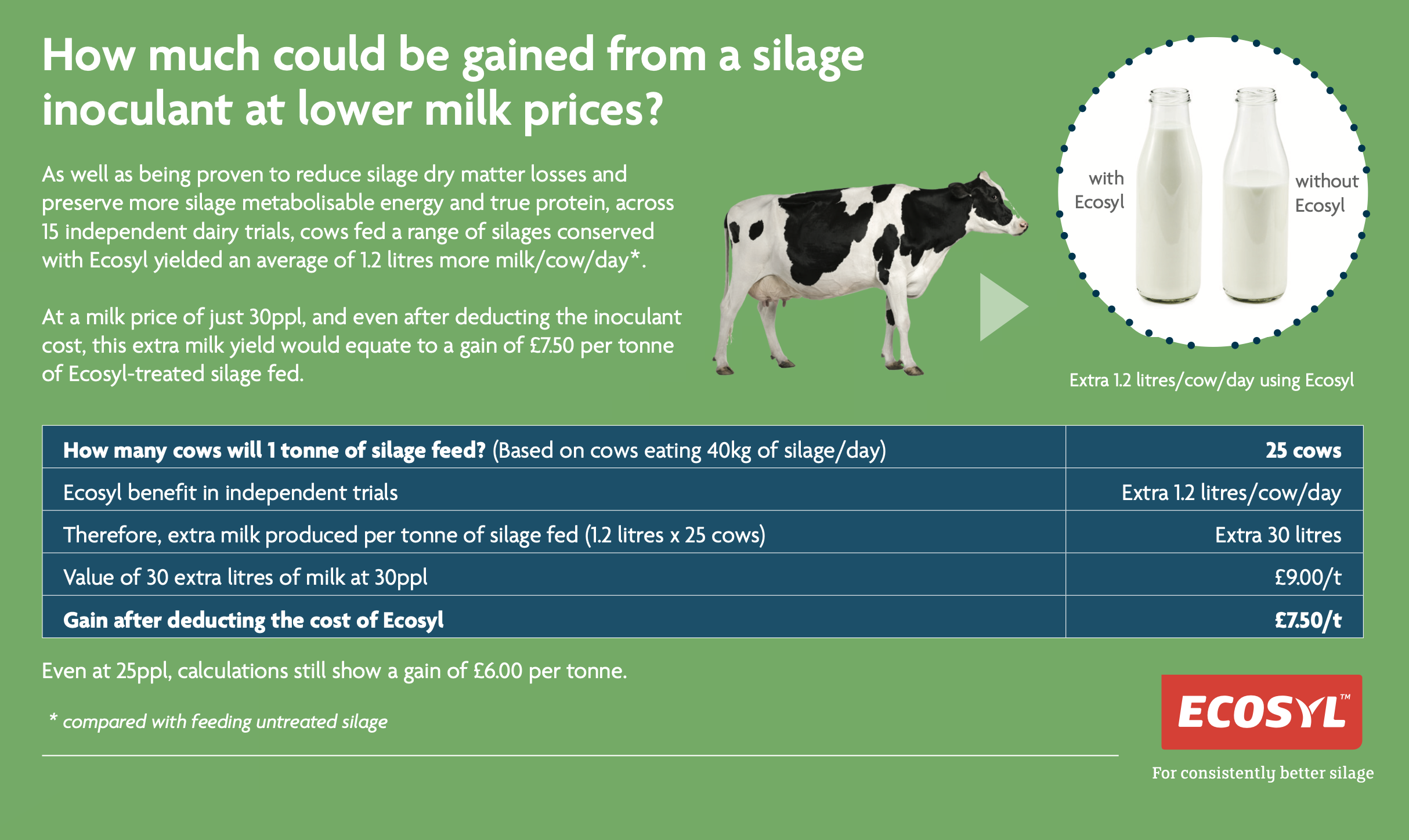
“When milk price drops, that’s when it’s imperative to use a proven additive to squeeze as much milk out as possible,” he stresses. “For example, trial work has found that using Ecosyl on grass silage roughly halves DM losses and delivers silage of higher metabolisable energy and higher true protein. That equals more milk in the tank.”