Use silage additive to optimise forage during low milk price
15 May 2026
Optimising silage quality and preventing unnecessary dry matter losses should be the primary focus for dairy farmers facing depressed milk price.
_original.jpeg?1741772379) That’s according to Ken Stroud Technical Business Manager for Volac, who believes all farmers could benefit from addressing fermentation losses.
That’s according to Ken Stroud Technical Business Manager for Volac, who believes all farmers could benefit from addressing fermentation losses.
You can’t control the milk price, but you have control over producing forage at a reasonable price. Ultimately, there’s no cheaper feed than homegrown forage, so the aim should always be to produce as much quality forage as possible to push milk from forage,” he says.
He believes there’s potential for farmers to make big gains by improving fermentation in the clamp, particularly considering around 10-15% of silage dry matter can be lost due to poor fermentation.
This stems around best practice clamp management including good consolidation, creating an airtight seal and providing good weighting to aid fermentation. Using a proven silage additive to “take control” of fermentation is also essential, he says.
Whilst you have control of chop length, compaction and sheeting, you have no control over the bacteria present on the crop – good or bad – which drive fermentation. With all silages it is important that the pH comes down quickly, and to a level low enough to stabilise the silage. The faster the pH falls, the sooner the wasteful activities of the live plant material and undesirable microorganisms will stop. This reduces losses, conserves more sugars and reduces protein breakdown,” Mr Stroud explains.
Ecosyl silage additive includes a dose of Lactiplantibacillus plantarum, strain MTD/1 which ferments plant sugars into beneficial lactic acid to rapidly drop the pH. Research has shown a much faster production of beneficial acidic conditions in the first 24 hours after ensiling with the treatment than without.
In trial work on grass ensiled at different percentage dry matters, Ecosyl roughly halved DM losses (average 94.7% of the original DM ensiled retained versus only 90.4% in the untreated). Based on a 1,000 tonne clamp ensiled at 30% DM, that equates to having 13t more DM available to feed.
Because there is more efficient fermentation, less bad bacteria are also able to grow and feed on silage nutrients. As a result, grass treated with Ecosyl has also been found to be higher in ME and protein versus untreated silage,” Mr Stroud adds.
“This just shows the value of using a proven additive, particularly during low milk price as that’s when it’s imperative to squeeze as much milk as possible out of forage,” he stresses.
Cost benefit of using a silage additive at lower milk prices
As well as being proven to reduce silage dry matter losses and preserve more silage metabolisable energy and true protein, across 15 independent dairy trials, cows fed a range of silages conserved with Ecosyl yielded an average of 1.2 litres more milk/cow/day compared with feeding untreated silage. At a milk price of just 30ppl, and even after deducting the additive cost, this extra milk yield would equate to a gain of £7.50 per tonne of Ecosyl-treated silage fed.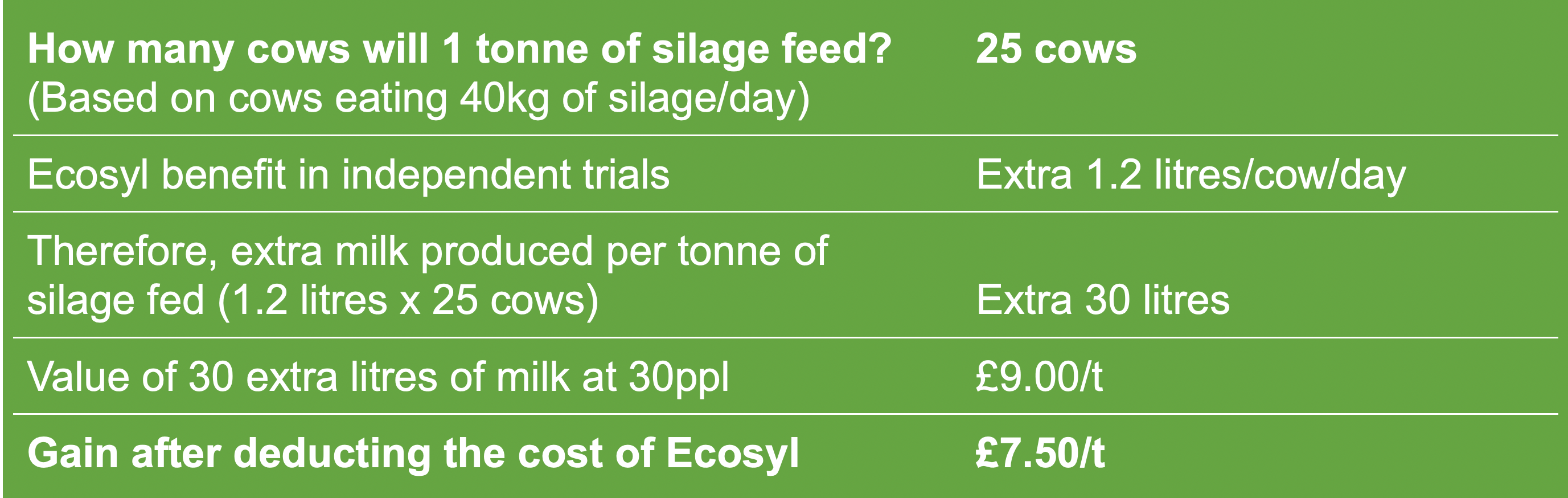
Even at 25ppl, calculations still show a gain of £6.00 per tonne.